What every RV owner should know before hitting the road.
We've all done it. Enter an address into Google Maps, Apple Maps, or Waze, hit Start, and follow the directions.
Simple enough, right?
That works great when you're driving a regular vehicle. But things get a little more complicated when you're towing a fifth wheel, travel trailer, or driving a large motorhome.
When we're traveling with our fifth wheel, we have a lot more to think about than whether the GPS found the fastest route. A road that's perfectly fine for a car might have a low bridge, a weight restriction, or a turn we'd rather not attempt with our home following behind us.
And here's the thing...
Your GPS might know exactly where you're going. But does it know what you're driving?
That's an important question every RV owner should ask before hitting the road.
The Problem Isn't the Map. It's What the Map Doesn't Know.
Google Maps, Apple Maps, and Waze are excellent navigation tools. We use them ourselves, and for everyday driving, they do a fantastic job of getting us where we need to go.
But when you're traveling with an RV, there's one important detail these applications don't account for.
They don't know the size or weight of what you're driving or towing.
These apps are primarily designed for passenger vehicles. Unlike RV-specific navigation systems, their standard driving modes don't allow you to enter your RV's height, length, or weight to calculate a route appropriate for your setup.
And that's where things can get interesting.
For example, our fifth wheel is approximately 13 and a half feet tall. Now imagine following Google Maps toward a bridge with a posted clearance of just 12 feet, 6 inches.
For someone driving a car, that bridge isn't a problem. But for us? There's absolutely no way we're going under it!
Suddenly, we're faced with finding another route, potentially somewhere that isn't easy to turn around with a large fifth wheel behind us.
A road that's perfectly suitable for a passenger vehicle might not be suitable for an RV.
And while low bridges are an obvious concern, narrow roads, tight turns, and weight restrictions can create similar challenges.
It's something that's easy to overlook when you're accustomed to simply following the directions on your phone.
Does That Mean We Should Stop Using Google Maps, Apple Maps, or Waze?
Absolutely not!
We still use these applications regularly. They're incredibly useful for finding restaurants, exploring attractions, checking traffic conditions, and navigating when we're not towing.
Google Street View and satellite imagery can even help us get a better look at unfamiliar roads, intersections, or campground entrances before we arrive.
The difference is knowing when to use them.
When we're driving around town without our fifth wheel, Google Maps or Apple Maps work great. But when we're towing our home down the highway, we prefer a navigation system that takes our RV's dimensions into consideration.
Because finding a route to your destination and finding a route that's appropriate for your RV aren't always the same thing.
What Makes RV-Specific GPS Navigation Different?
Think about the information you give Google Maps when you're heading somewhere. You enter your destination, select driving directions, and you're on your way.
Now imagine being able to tell your GPS that you're towing a fifth wheel that's 13 and a half feet tall, how long your entire setup is, and how much it weighs.
That's where RV-specific navigation comes in.
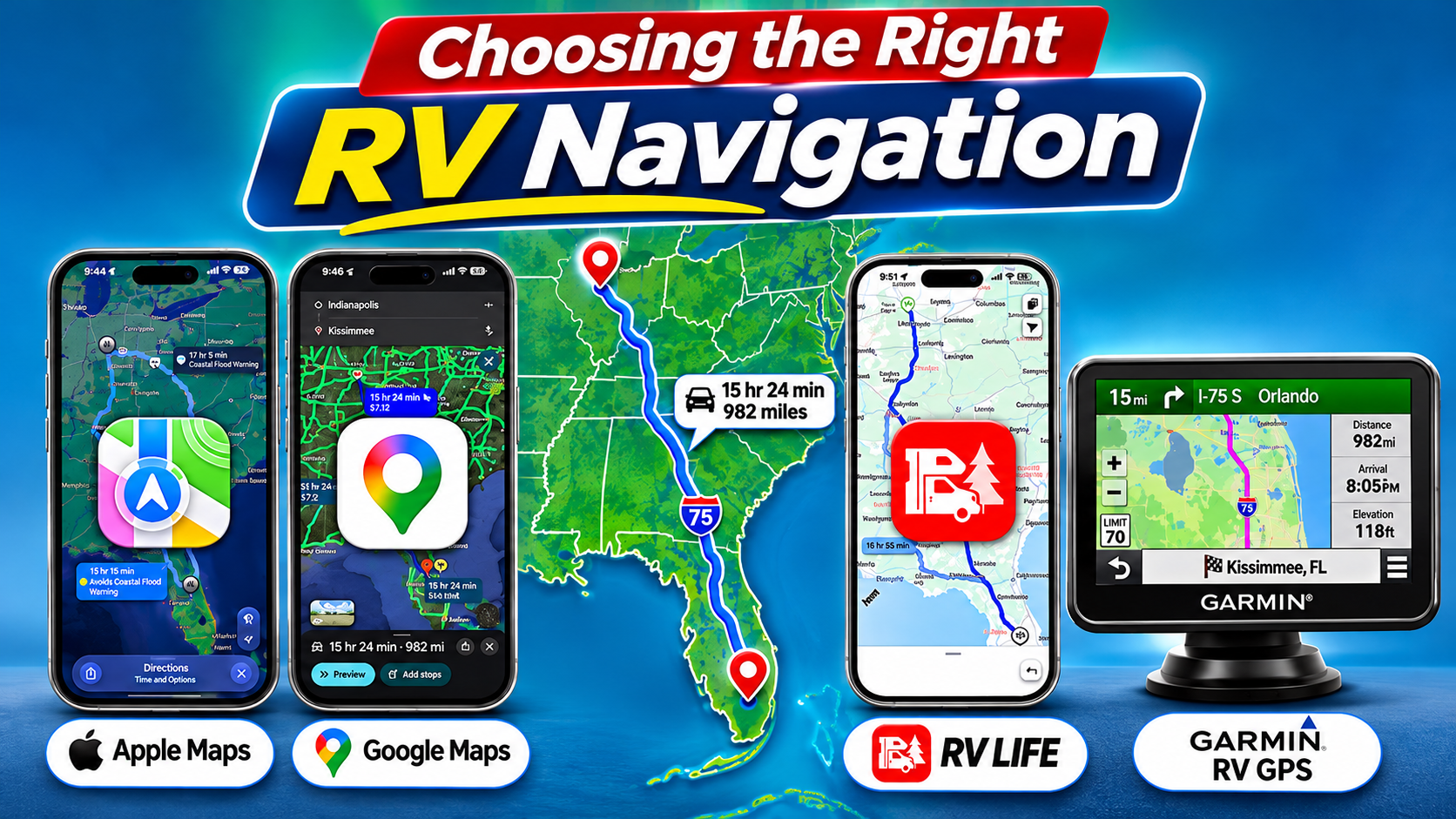
Applications like RV LIFE GPS and dedicated devices like Garmin's RV GPS models allow you to create a vehicle profile using your RV's measurements.
When calculating a route, these systems use that information, along with available road restriction data, to help identify roads that may not be appropriate for your RV.
Remember our low-clearance bridge example?
If your RV is 13 feet, 6 inches tall and the navigation system has accurate information showing a bridge is only 12 feet, 6 inches high, an RV-specific GPS can recognize that restriction and route you around it.
Standard consumer navigation apps don't make that same calculation using your RV's dimensions.
And here's another important distinction: You don't necessarily need to purchase a dedicated GPS device to benefit from RV-specific navigation.
Dedicated Garmin RV GPS units offer vehicle-specific routing through their own navigation hardware, while applications like RV LIFE Pro provide RV-specific turn-by-turn directions through your smartphone.
Both approaches help you make more informed navigation decisions by considering the size and weight of the RV you're traveling with.
What We Use at VNR Adventures
When we're traveling with our fifth wheel, we use RV LIFE, which combines RV-specific trip planning with GPS navigation.
We've shared how we plan our trips in two previous articles:
Those articles focus on how we choose destinations, find campgrounds, and organize our travels before leaving.
But planning a trip and navigating it are two different things.
With RV LIFE GPS, we can create a vehicle profile using our RV's dimensions and weight. That information helps the application calculate turn-by-turn directions that are better suited to our fifth wheel.
We can also download maps ahead of time for offline navigation, which is particularly helpful when traveling through areas where cellular service isn't always reliable.
For us, it's one more way to take some of the guesswork out of travel days.
If you're interested in learning more, you can explore RV LIFE Pro here.
Affiliate disclosure: This section contains an affiliate link. If you purchase through our link, we may earn a commission at no additional cost to you.
Of course, RV LIFE isn't the only option. Some RV owners prefer a dedicated Garmin GPS with its own screen, while others prefer an application on their smartphone.
Neither approach is necessarily better for everyone. What matters is finding a navigation solution that works for your RV and how you prefer to travel.
Even RV-Specific Navigation Requires Common Sense
There's one thing we want to make very clear.
No GPS application should ever replace paying attention to the actual road.
Even RV-specific navigation systems can encounter outdated information, temporary road closures, construction, or restrictions that aren't reflected in their maps.
And remember, these systems depend on the information you provide.
Before your next RV trip, make sure you know your RV's actual traveling height, overall length, and weight.
Your traveling height should include rooftop equipment such as air conditioners, antennas, or anything else that adds to the overall height of your RV. Don't automatically assume the manufacturer's published specifications account for everything installed on your roof.
For those towing, overall length means accounting for both your tow vehicle and trailer, not just the RV itself. You'll also want to use accurate weight information for your traveling setup.
Entering the correct measurements helps an RV-specific GPS make better routing decisions.
It's also worth reviewing your route ahead of time, checking campground arrival instructions, and paying close attention to posted road signs.
And if your GPS tells you to make a turn that doesn't look right?
Don't blindly follow it.
Find a safe place to stop and review your options before continuing.
A few extra minutes of preparation can prevent a much bigger problem later.
Final Thoughts: The Fastest Route Isn't Always the Best Route
One of the things we've learned throughout our RV travels is that getting to the destination isn't a race.
We're not particularly interested in saving five or ten minutes if it means traveling down roads that make towing more difficult than it needs to be.
Google Maps, Apple Maps, and Waze are excellent tools, and we'll continue using them when they're appropriate.
But when we're towing our fifth wheel, we want navigation that considers more than just the distance between two points.
We want it to consider what we're bringing along for the ride.
Because at the end of the day, the best route isn't necessarily the fastest one. It's the one that gets you and your RV to your destination safely.
Travel. Explore. Inspire.