RV Owners Need to Stop Excusing Poor Quality
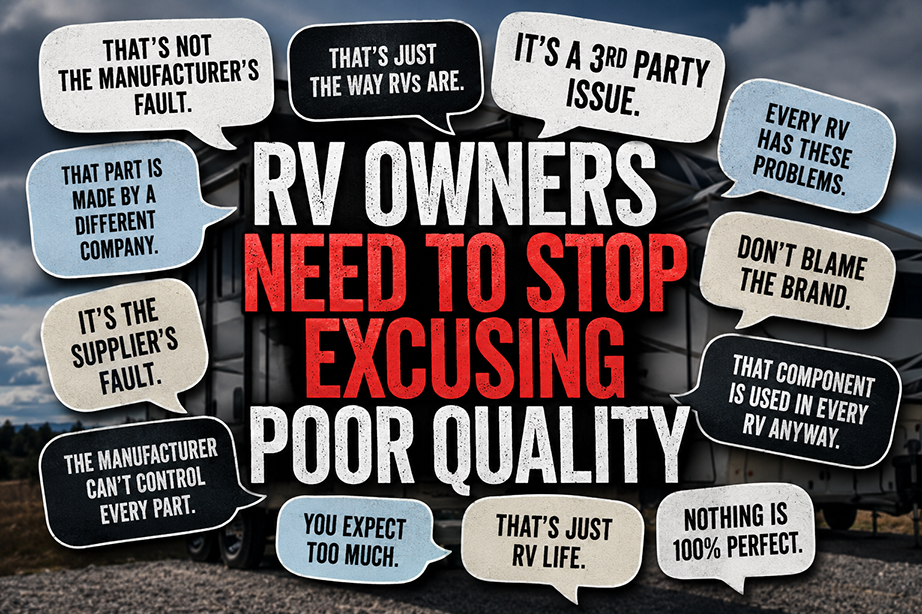
Spend enough time in RV Facebook groups, forums, Reddit threads, or YouTube comments and you’ll notice a pattern.
Someone posts about a major issue with their RV:
a leaking slide,
failed electronics,
water damage,
plumbing leaks,
a bad air conditioner,
loose wiring,
or a major repair shortly after purchase.
And almost immediately, the responses begin:
“That’s the supplier’s fault.”
“That component is made by a third party.”
“Every manufacturer uses those parts.”
“That’s not really the RV company’s issue.”
Somewhere along the way, many RV owners started separating the RV manufacturer from the quality of the RV itself.
And honestly, that mindset deserves a larger conversation.
Because while suppliers absolutely play a role in RV quality problems, RV manufacturers still own responsibility for the final product being sold.
That does not mean suppliers are innocent.
And it does not mean RV manufacturing is simple.
But at some point, “that’s just RV life” became an excuse for problems consumers would never tolerate in almost any other industry.
The “It’s the Supplier’s Fault” Argument
To be fair, RV manufacturers rely heavily on outside suppliers.
Modern RVs are built using components from dozens of different companies:
frames,
axles,
appliances,
air conditioners,
slides,
water heaters,
electronics,
leveling systems,
plumbing components,
control systems,
and more.
That part is absolutely true.
And in some situations, RV owners even work directly with third-party suppliers during the warranty process. Certain component manufacturers may authorize repairs, ship replacement parts, or provide technical support directly to owners and dealerships.
So yes, suppliers absolutely share responsibility in many cases.
But here’s the part that often gets overlooked:
The RV manufacturer still:
selected those suppliers,
approved those components,
integrated those systems,
installed them,
tested them,
and ultimately sold the finished RV under their own brand name.
Consumers are not purchasing a random collection of outsourced parts.
They are purchasing a finished product with a manufacturer’s name attached to it.
And that distinction matters.
We Don’t Think This Way About Cars or Phones
What makes this conversation so interesting is that we do not apply this logic to almost any other industry.
Take smartphones for example.
Samsung manufactures displays used in many iPhones.
But imagine if iPhone screens suddenly started failing constantly.
Consumers would not say:
“Well technically that’s Samsung’s fault, not Apple’s.”
They would hold Apple accountable because Apple:
selected the supplier,
approved the component,
integrated the product,
and sold the final device.
The same thing happens in the automotive industry.
Ford vehicles contain thousands of third-party components sourced from suppliers all over the world. But if transmissions started failing across a vehicle lineup, consumers would blame Ford, not the transmission supplier buried somewhere in the supply chain.
Why?
Because consumers buy the finished product.
Not a pile of supplier parts.
And honestly, RVs should not be treated differently.
The RV Industry Has Become More Complex Than Ever
This conversation matters even more today because modern RVs are no longer simple campers.
Today’s RVs contain:
multiplex wiring systems,
app-controlled electronics,
smart monitoring systems,
solar integration,
lithium battery systems,
automatic leveling,
wireless tank monitoring,
inverters,
networked control panels,
CANBUS communication,
and interconnected electrical ecosystems.
In many ways, RV manufacturers have evolved into large-scale systems integrators.
That means integration quality matters just as much as the quality of the individual components themselves.
A perfectly good component can still become part of a terrible ownership experience if:
it’s installed poorly,
wired incorrectly,
tested inadequately,
rushed through production,
or integrated into an unreliable overall system.
And ultimately, the RV manufacturer is the one responsible for bringing all of those systems together into a finished product.
Why Accountability Actually Matters
Some people may read this and think:
“Who cares whose fault it is?”
But accountability directly impacts improvement.
When consumers constantly excuse manufacturers:
weak quality control gets normalized,
supplier problems continue,
rushed production becomes accepted,
poor integration standards remain,
and manufacturers face less pressure to improve.
Meanwhile, consumers are left dealing with:
repeated warranty visits,
months waiting for repairs,
canceled trips,
water damage,
electrical issues,
and the stress of fixing problems in RVs that often cost well into six figures.
And honestly, that should not be considered normal.
Especially in an era where RV prices continue climbing higher and higher.
The reality is simple:
consumer expectations shape industries.
We’ve seen that happen in:
automotive,
consumer electronics,
appliances,
gaming hardware,
and countless other industries.
When consumers consistently demand better:
companies adapt,
suppliers improve,
quality control improves,
engineering improves,
and reputations begin to matter more.
Today, RV owners have more influence than ever through:
Facebook groups,
Reddit,
YouTube,
blogs,
online reviews,
and social media.
Manufacturers absolutely pay attention to perception now.
Which means accountability matters more than ever.
The RV Industry Has Normalized Too Much
Here’s the uncomfortable truth:
The RV industry has normalized things that would trigger recalls, buybacks, or widespread outrage in many other industries.
Things like:
water leaks,
roof failures,
plumbing leaks,
loose wiring,
poor sealant work,
cabinet failures,
slide alignment issues,
electrical gremlins,
incomplete PDI inspections,
and major repairs shortly after purchase.
And somehow, many owners have simply accepted this as:
“part of RV life.”
But honestly, why?
Why should consumers normalize major quality issues on products that now regularly cost:
$80,000,
$120,000,
$200,000+,
or even more?
At some point, premium pricing should come with premium accountability.
And to be clear, this is not saying every RV is bad.
There are absolutely owners with fantastic experiences.
There are also hardworking employees throughout the industry who genuinely care about what they build.
But the overall industry standard still feels far too accepting of issues that would feel completely unacceptable elsewhere.
And that’s the bigger problem.
Suppliers Do Share Responsibility
None of this means suppliers should get a free pass.
Some suppliers absolutely produce unreliable components.
Some recurring industry-wide problems clearly originate from specific parts or systems.
And some failures genuinely are tied directly to the component manufacturer itself.
That’s real.
But even then, the RV manufacturer still:
chose the supplier,
approved the component,
integrated the system,
and continued using those parts in their RVs.
That responsibility does not disappear simply because another company manufactured the component.
At the end of the day, the customer relationship is still with the RV manufacturer, not the supplier.
Why RV Owners Defend Manufacturers So Strongly
This is also where the conversation becomes emotional.
Because RV ownership is deeply personal for many people.
An RV often represents:
freedom,
adventure,
retirement dreams,
family memories,
travel,
or an entirely new lifestyle.
People spend enormous amounts of money on these rigs.
They join owner groups.
They build friendships around brands.
They emotionally invest in the experience.
So when criticism appears, it can sometimes feel like criticism of:
their purchase decision,
their community,
or even the lifestyle itself.
And honestly, that reaction is understandable.
But wanting better quality should not be viewed as “hating.”
Constructive criticism and accountability are how industries improve.
In many ways, the loudest critics are often the people who love the lifestyle the most.
Because they want the experience to live up to the promise.
What Real Improvement Could Look Like
If the RV industry truly wants to improve long-term trust and reputation, meaningful changes need to happen in areas like:
incoming quality control,
production consistency,
testing procedures,
supplier standards,
dealer accountability,
warranty support,
communication,
and long-term reliability expectations.
It also means manufacturers being willing to stop relying on suppliers with consistently poor track records, even if switching suppliers impacts cost or production timelines.
Because eventually, consumers notice patterns.
And once trust erodes, rebuilding it becomes much harder.
Especially in today’s internet-driven world where ownership experiences spread quickly online.
Final Thoughts
Holding RV manufacturers accountable is not negativity.
It’s not “brand hate.”
It’s not unrealistic expectations.
And it’s not complaining just to complain.
Most RV owners speak up because they genuinely love this lifestyle and want the experience to improve for everyone entering it.
That includes:
better quality,
better reliability,
better customer support,
better engineering,
and better long-term ownership experiences.
The goal is not to tear manufacturers down.
The goal is to push the industry toward building RVs that truly match the lifestyle, expectations, and price tags attached to them.
And honestly, that’s a conversation worth having.