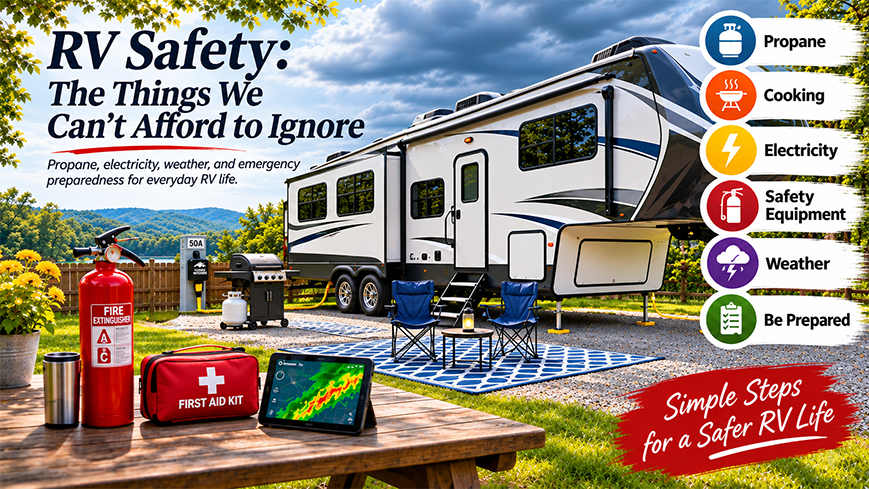
Living in an RV comes with a lot of freedom. We get to travel, explore new places, and bring our home along for the adventure. But with that freedom comes responsibility, especially when it comes to safety.
Recently, something happened at our campground that reminded us just how quickly an ordinary day can turn into an emergency.
A neighbor was preparing lunch on his outdoor propane grill when something went terribly wrong. From what we later learned, there was a sudden release of gas, followed by a frightening incident involving a propane tank that ended up burning underneath his RV.
He suffered burns to his hand while trying to deal with the situation. When he reached for his fire extinguisher, it didn't work.
Thankfully, nearby campers heard his calls for help and came running with their own extinguishers. Emergency responders arrived shortly afterward.
We don't know exactly what caused the incident, and we're not going to speculate. But witnessing something like that makes you think about the things we rely on every day.
Just because we use something regularly doesn't mean we should forget what can go wrong.
Propane: Convenient, but Not Without Risk
Propane is part of everyday RV life. Depending on your setup, it may power your stove, oven, furnace, water heater, or outdoor grill.
While propane is generally safe when equipment is properly installed, maintained, and operated, it's something we should never take for granted.
A few things every RVer should remember:
Know where your propane shutoff valves are located.
Inspect accessible hoses, connections, and tanks for visible damage.
Have propane systems inspected and serviced by qualified technicians.
Never ignore the smell of propane or an activated propane detector.
Keep portable propane cylinders upright, secured, and outdoors in properly ventilated locations.
If you suspect a propane leak, treat it as an emergency. Don't attempt to locate the leak yourself or operate anything that could create a spark. Get everyone away from the area, shut off the propane only if it's safe to do so, and contact emergency services or your propane supplier from a safe location.
Don't return until the area has been declared safe, and have the system inspected before using it again.
For more information, the Propane Education & Research Council provides helpful propane safety guidance.
Cooking: Don't Let Familiarity Become Complacency
Whether you're cooking breakfast inside or grilling burgers outside, you're working with heat and, in many cases, an open flame.
We all get distracted. Someone calls, the dog needs attention, or we step away to grab something.
But cooking is one of those activities that deserves our full attention.
Stay near your stove or grill while it's operating. Keep towels, paper products, and other flammable materials away from burners. Make sure propane burners ignite properly, and follow the manufacturer's instructions if they fail to light.
Never use your propane stove or oven to heat your RV, and make sure you're following the appliance's ventilation requirements.
If something doesn't seem right, stop using the appliance until the problem has been identified and corrected.
Lunch can wait. Your safety can't.
Electricity: Pay Attention to the Warning Signs
Electricity is another thing we rarely think about until something stops working.
Our RVs depend on electrical systems for everything from air conditioning and refrigeration to charging our devices.
But unlike a traditional house, an RV travels down highways, experiences constant vibrations, and connects to different electrical pedestals along the way.
That makes regular inspections important.
Check your shore power cord, plugs, and adapters for damage or discoloration. Never ignore burning smells, buzzing connections, unusually hot plugs, or outlets that aren't functioning correctly.
A properly rated RV electrical management system (EMS) can help protect against certain campground power problems, but it doesn't replace proper maintenance.
And when it comes to electrical repairs, know your limits. Sometimes the safest thing you can do is call a qualified RV technician or electrician.
Your Safety Equipment: Does It Actually Work?
This might be the biggest lesson from what happened at our campground.
Our neighbor had a fire extinguisher.
Unfortunately, when he needed it most, it didn't work.
That should make every one of us think about the safety equipment inside our own RV.
When was the last time you checked yours?
Every RV should have appropriate, functioning safety equipment, including:
Smoke alarms: To alert you to a possible fire.
Carbon monoxide detectors: To warn of dangerous CO buildup from fuel-burning equipment.
Propane detectors: To detect potentially dangerous propane gas concentrations.
Fire extinguishers: Properly rated, accessible, maintained, and ready for use.
Test your alarms according to the manufacturer's instructions and check their replacement dates. Remember that different detectors protect against different hazards.
Inspect your fire extinguisher regularly, preferably monthly. Check its pressure gauge, safety pin, overall condition, and accessibility. Don't forget to check its manufacture date, too. Fire extinguishers don't last forever, and replacement or servicing requirements vary by model.
If you're unsure how to check yours, Kidde offers helpful guides on how to inspect and maintain your fire extinguisher and how to locate its manufacture date.
A few minutes of inspection could make all the difference when you need it most.
And remember, a fire extinguisher isn't a reason to stay and fight a dangerous fire. Only consider using one on a small, contained fire if you're trained, have a clear escape route, and can do so safely. If propane is leaking or a cylinder is involved in a fire, move away, warn others, and call 911.
Your safety and your family's safety always come first.
Weather: The Danger We Sometimes Forget
Not every RV emergency starts with propane or electricity.
Sometimes, the biggest danger comes from outside.
One thing we've learned from full-time RV living is that weather should always be part of your travel planning.
Planning an extended stay in a tornado-prone region during peak severe-weather season? Make sure you understand the risks.
Spending summer or fall in Florida? Atlantic hurricane season runs from June 1 through November 30, and keeping an eye on tropical activity should be part of your routine.
That includes watching systems developing off the coast of Africa, in the Caribbean, and in the Gulf.
But weather awareness goes beyond hurricanes and tornadoes. Severe thunderstorms, flooding, damaging winds, extreme temperatures, and winter storms can all affect your safety.
Before traveling, consider a few important things:
Understand the seasonal weather risks at your destination.
Monitor forecasts and severe-weather alerts.
Know where to find appropriate shelter if severe weather approaches.
Have a backup destination or RV-safe travel route available.
Be willing to change your plans when conditions become unsafe.
An RV is not a safe place to shelter during a tornado. Know where the nearest sturdy building or designated storm shelter is located before severe weather arrives.
And remember, there's a big difference between evacuating early to avoid a storm and attempting to travel when dangerous weather is already approaching.
Sometimes the safest decision is to leave early. Other times, it's to postpone travel or seek appropriate shelter.
Your reservation can be changed. Your travel plans can wait.
Your safety cannot.
For reliable weather information, we recommend the National Weather Service, Storm Prediction Center, and National Hurricane Center.
Have a Plan Before You Need One
We hope none of us ever experiences an emergency like the one we recently witnessed.
But hoping something won't happen isn't the same as being prepared.
Know how to exit your RV in an emergency, including how to use the emergency escape windows. Make sure everyone traveling with you understands the plan and knows where to meet outside.
If you travel with pets, think about how you'll get them to safety, too.
Keep emergency supplies accessible, know your campground's emergency procedures, and make sure your safety equipment is ready.
And if you haven't checked these things recently, maybe today is a good day to do it.
A Few Minutes of Prevention Can Make a Difference
We aren't sharing this because we think RV living is dangerous.
We live in ours full-time, and we rely on these same systems every single day.
But watching emergency vehicles arrive at a neighboring campsite and seeing someone injured during what should have been a normal afternoon was a reminder of how quickly things can change.
It also reminded us how fortunate we are to be surrounded by fellow campers willing to help when someone needs it.
Safety equipment doesn't replace safe habits. And safe habits don't replace functioning safety equipment. We need both.
So take a few minutes today. Check your detectors. Inspect your fire extinguisher. Look at your electrical connections. Know where your propane shutoff is located. Pay attention to the weather. And think about what you would do if an emergency happened right now.
Because the best time to prepare for an emergency is long before you find yourself facing one.
Stay safe, travel smart, and keep enjoying the adventure.
This post is part of our RV Life 101 series — a beginner-friendly guide to the essentials of RV living.
👉 See all RV Life 101 posts here