How RV Life Changed the Way We See “Stuff”
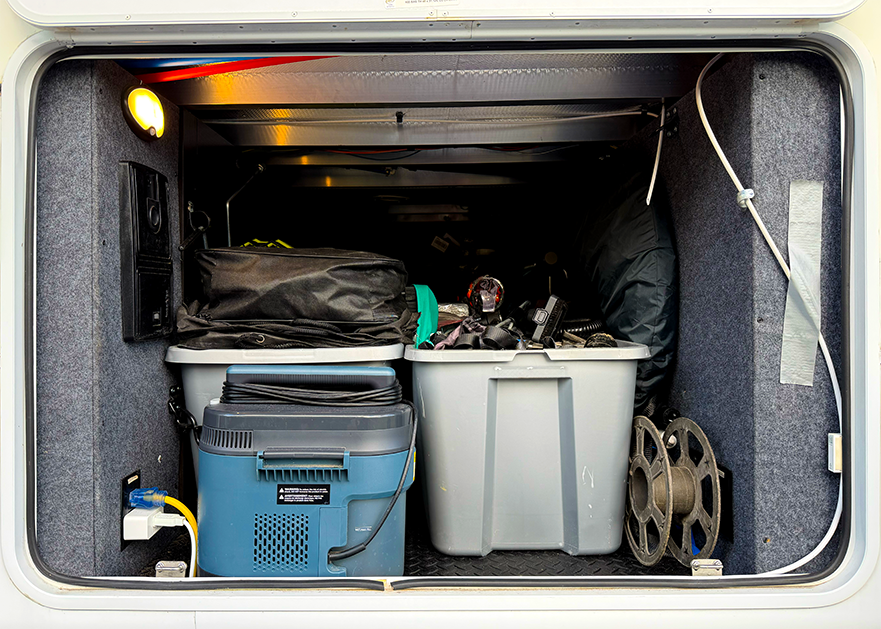
When we moved into our fifth wheel full-time, we truly believed we had brought only what we needed. We sold most of what we owned, donated even more, and carefully kept the items we felt were essential. But here’s the thing about RV life: once you’re actually living in it day after day, the word “essential” suddenly becomes a much smaller category.
It didn’t take long for RV living to hold up a mirror to everything we’d packed and quietly ask:
“Do you really need this?”
That simple question changed everything.
The “Just in Case” Trap
If RVers had a universal motto, it would probably be:
“Better bring it… just in case.”
We brought plenty of “just in case” items. Everything had its place and nothing felt messy, but tucked inside those cabinets were things we weren’t actually using. These items felt important when we packed them, yet once we hit the road, they revealed themselves as emotional security blankets rather than practical necessities.
It’s easy to assume you’ll need that extra tool, that specialty kitchen gadget, or that bulky gear for a rare scenario you imagined months ago. RV life eventually teaches you that “just in case” can quickly turn into “just taking up space and adding weight.”
The Things We Brought but Barely Touched
Once we paid attention to our daily routine, it became clear which items were simply coming along for the ride.
Some examples:
Beach gear we thought we'd use constantly
Extra totes of miscellaneous items that didn’t fit the way we actually live
Workout weights that never moved unless we needed what was underneath them
Cookware that made sense in a house but not so much in an RV
Everything was tucked away neatly, but neat doesn’t always mean necessary. And as we’d soon discover, neat definitely doesn’t mean lightweight.
The Hidden Reality Behind RV Weight
Many new RVers (including us) assume that if everything fits, everything is fine. But RVs don’t care how tidy your storage is. They care how heavy it is.
Weight affects:
Handling
Braking distance
Tire health
Suspension strain
Safety for you and everyone around you
Even though our RV never felt overloaded, we had never actually checked our numbers. And once we realized how much extra “just in case” stuff we were carrying, we decided it was time to stop guessing.
The CAT Scale Wake-Up Call
When we finally pulled onto a CAT Scale, we expected to be somewhere in the general range.
Maybe a little high.
Maybe a little low.
But not too far off.
Well… we were off.
We were 1,180 pounds overweight!
Seeing that number hit harder than we expected. Not in a panicked way, but in a “wow, we really needed to know this” kind of way. All those small, unused items added up far more than we realized.
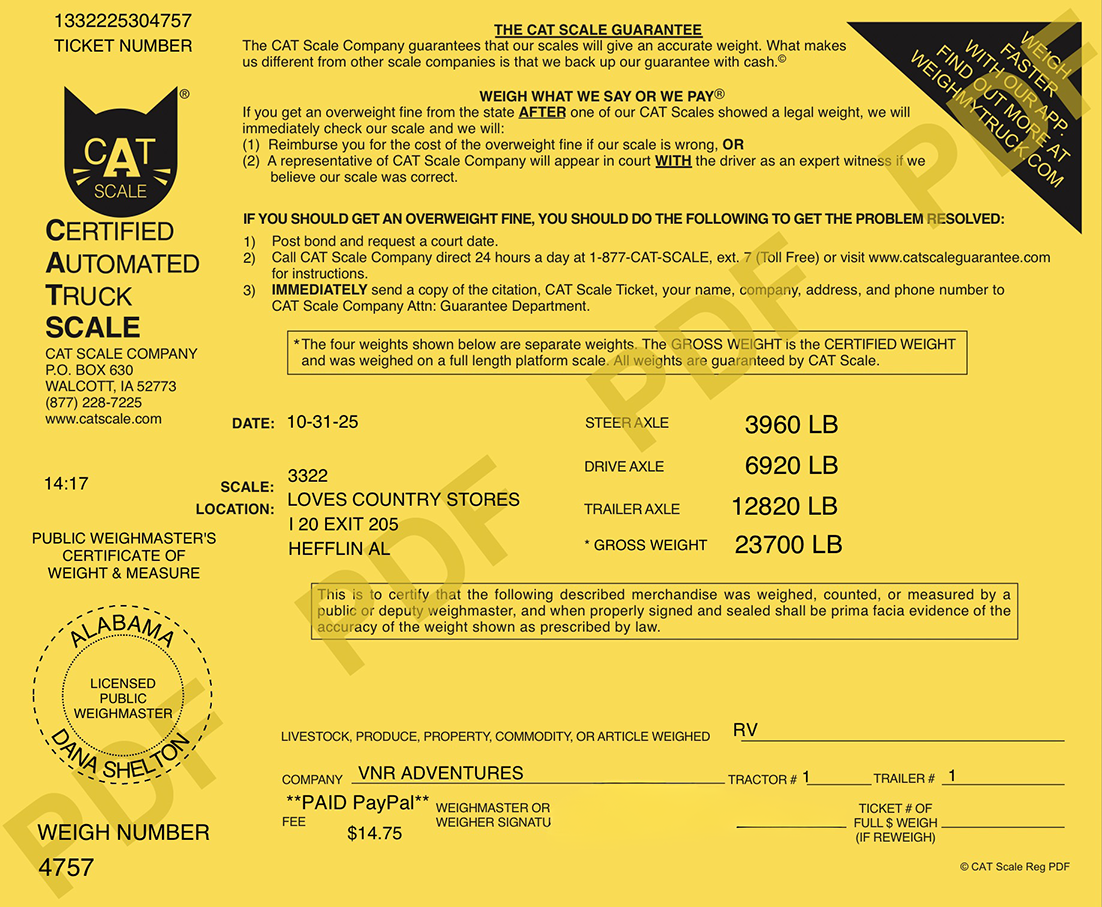
Full Combination Weight (Truck + RV Together)
This weigh-in showed our complete setup — truck and RV attached. Using the truck-only weight from the second ticket (below), we calculated the RV’s actual loaded weight at 23,700 lbs (combined) – 7,520 lbs (truck alone) = 16,180 lbs for the RV. Our RV's GVWR is 15,000 lbs, which means we were 1,180 lbs over our safe limit.
This was the moment we realized how much our unused and “just in case” items had added up.
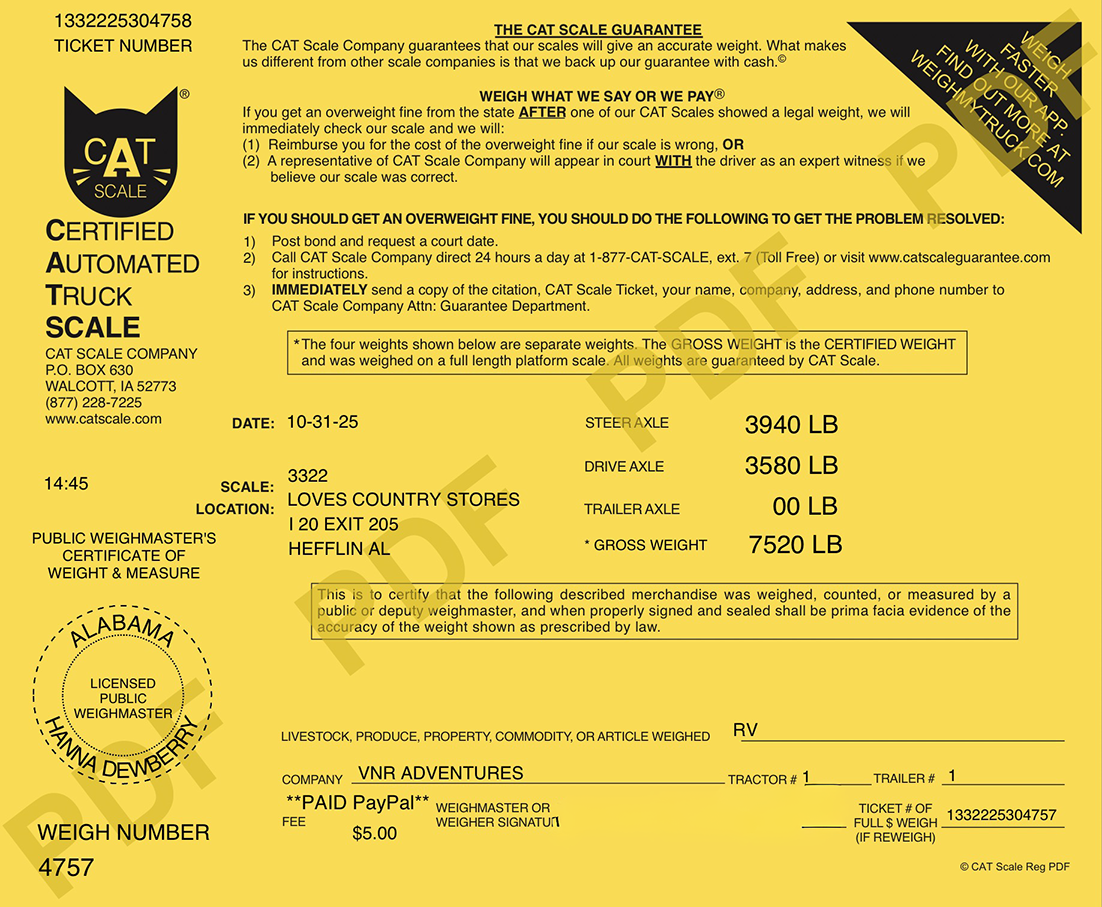
Truck-Only Weight (Without the RV Attached)
This weigh-in shows our truck by itself, weighing 7,520 lbs. Using this number, we calculated our RV’s true loaded weight by subtracting it from the combined total on the first ticket. This helped us understand how much weight the RV was actually carrying and confirmed that the RV, not the truck, was the source of the overload. This is exactly why weighing both together and separately is so important.
What We Adjusted After Seeing Our Weight
Once we had our numbers, we knew exactly what needed to happen next.
We went through every storage area and asked one simple, honest question:
“Have we used this even once since moving into the RV?”
If the answer was no, and it wasn’t essential for repairs, safety or a “must have”, it went into a donation or “sell” pile.
We:
Removed items we weren’t using
Re-evaluated clothes, kitchen tools, and occasional items
Cut down duplicates and bulky pieces
Shifted heavier things to improve weight distribution
Donated and sold everything that no longer fit our lifestyle
After making those changes, we weighed in again.
Here’s our new CAT Scale ticket after downsizing:
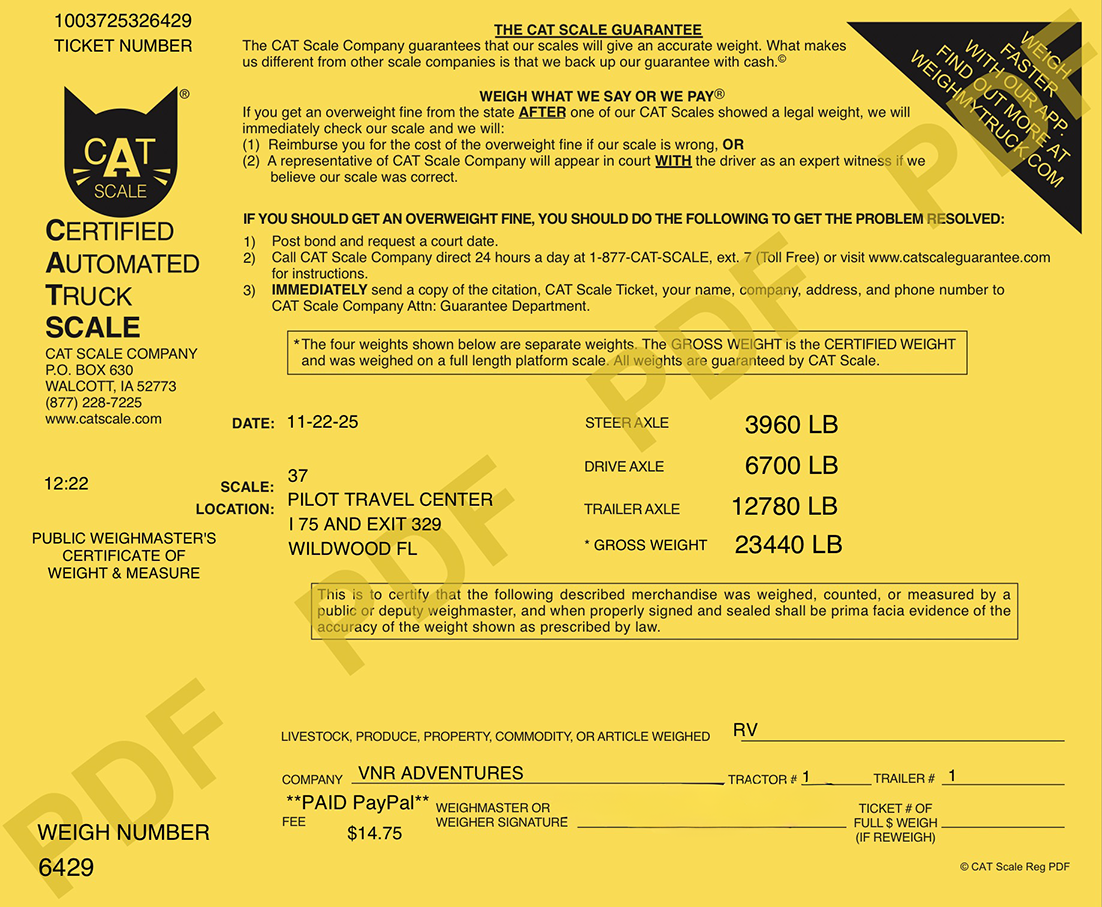
Full Combination Weight After Downsizing (Truck + RV Together)
This weigh-in shows our updated setup after clearing out unused items and adjusting weight distribution. Our new combined weight came in at 23,440 lbs, with the truck carrying 10,660 lbs and the RV weighing 15,920 lbs. Compared to our first weigh-in, here’s what actually changed:
We removed 260 lbs from the RV
We took 220 lbs off the truck (all from the rear axle)
Pin weight dropped from 3,360 lbs → 3,140 lbs
Pin weight percentage improved to 19.7%, right within the ideal range
Even with these improvements, we’re still exploring other ways to lighten our setup, both by removing more unnecessary items and by looking at future upgrades like moving to a dually truck for better payload capacity.
Letting Go: How Downsizing Actually Felt
Here’s something people rarely talk about: downsizing feels really good.
Our RV didn’t suddenly look different. It was already tidy. But the way it felt changed. Travel days became easier. Storage felt more balanced. And we stopped holding onto items “just because.”
Letting go didn’t feel like losing anything.
It felt like gaining clarity.
What We Kept and Why It Matters
Downsizing doesn’t mean stripping away the things that make RV life comfortable. It means choosing with intention.
Some items absolutely earned their place:
Our smart home setup
Quality cookware we use daily
Tools and repair items we genuinely rely on
Technology that supports our routine
These aren’t extras. They’re part of what makes our RV feel like home.
How We Shop Now
RV life completely changed how we evaluate new purchases.
Before anything comes into our home, we ask:
Do we need it?
Will we use it?
Does it solve a real problem?
Do we have the space and weight for it?
Is it a want pretending to be a need?
This approach doesn’t limit us. It keeps our home feeling balanced and intentional.
Why You Should Weigh Your Rig Too
If there’s one thing we hope you take away from this blog, it’s this:
👉 Go weigh your rig.
A CAT Scale stop gives you:
Steer axle weight
Drive axle weight
Trailer axle weight
Total combined weight
No more guessing and no more assumptions. Just real information that helps you travel safely and confidently.
It’s not about perfection.
It’s about peace of mind.
Less Stuff, More Life
RV life taught us something we didn’t expect:
You don’t need more things to feel comfortable.
You need the right things.
Letting go of the extras gave us:
Space
Safety
Clarity
Flexibility
Freedom
Freedom to enjoy the journey instead of managing the stuff we brought along for it.
Less stuff. More life. That’s the heart of RV living.
Author’s Note
Thank you for spending time with us today. Whether you’re downsizing, organizing, or simply dreaming about RV life, we hope our experience encourages you to look at your setup with curiosity, not pressure. If you ever want to talk RV life, downsizing, or weigh-ins, we’re always happy to share what we’ve learned. Safe travels, friends. ❤️

This post is part of our RV Life 101 series — a beginner-friendly guide to the essentials of RV living.
👉 See all RV Life 101 posts here